What Are the Four Main Types of Family Mediation?
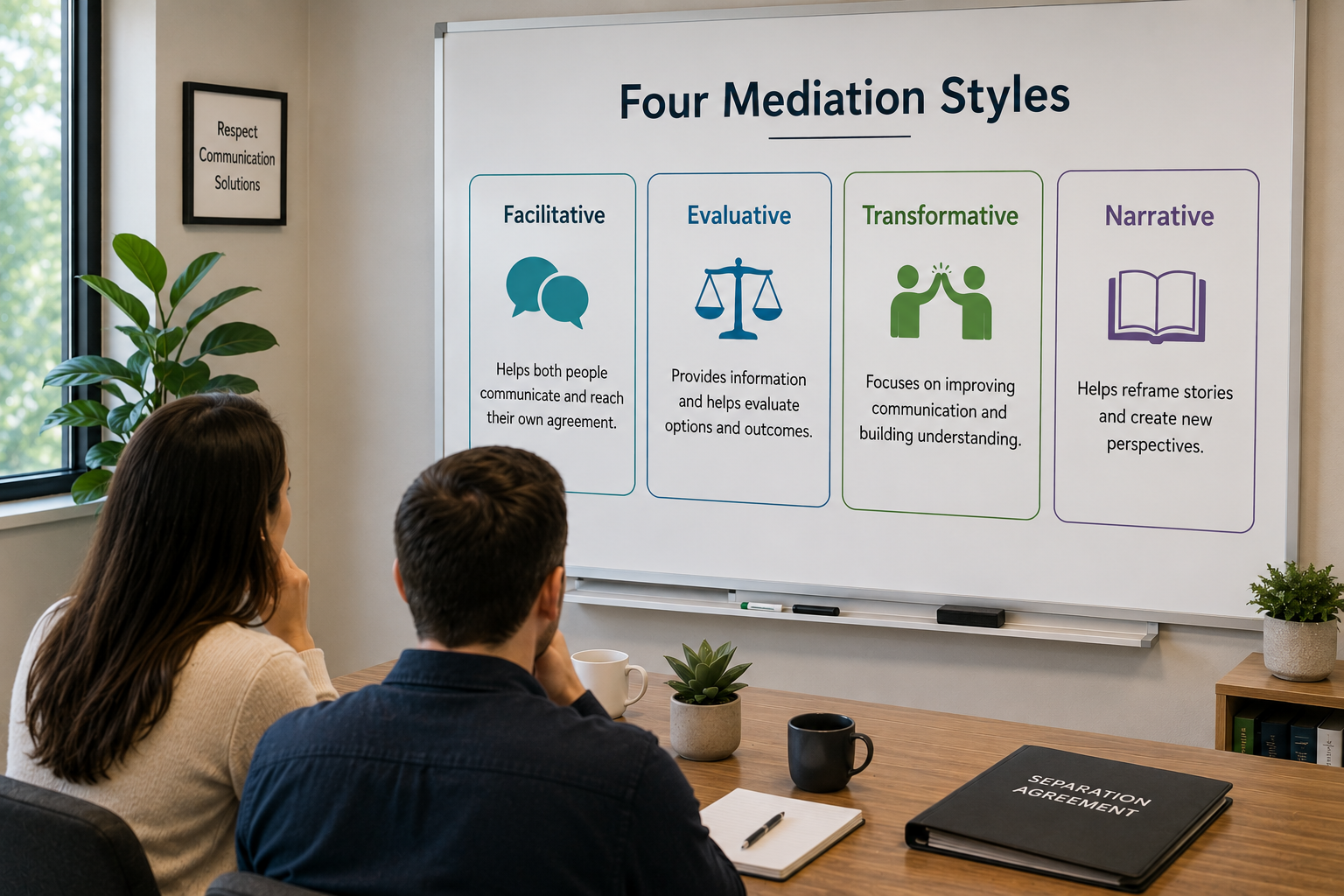
Many people assume that all family mediators work the same way, but there are actually four recognized mediation styles. Each approach has its strengths, and the best mediator knows when to use each one depending on the needs of the family.
Understanding these different styles can help you choose the right family mediator for your situation.
If you’d like to learn more about the mediation profession and professional standards in Ontario, the Ontario Association for Family Mediation (OAFM) provides additional information about family mediation and accredited family mediators.
Mediation Style | Primary Focus | Best For |
Facilitative | Guided Discussion | Most separating couples |
Evaluative | Reality testing and legal outcomes | Complex legal issues |
Transformative | Improving communication | High conflict and co-parenting |
Narrative | Reframing Conflict | Long-standing relationship dynamics |
Facilitative Mediation
A facilitative mediator focuses on helping both people communicate effectively, identify the issues they need to resolve, explore possible solutions, and reach their own agreements. Rather than making decisions for the couple, the mediator guides productive discussions while remaining neutral throughout the process.
This is the approach I primarily use because I believe the people involved should remain in control of the decisions that will affect their family for years to come.
Evaluative Mediation
An evaluative mediator takes a more directive approach by helping couples understand the strengths and weaknesses of their positions. They may explain how a court could view certain issues or discuss likely legal outcomes if the matter proceeded through the court system.
While I don’t make decisions for clients, I do provide extensive education about Ontario family law, helping couples understand realistic outcomes so they can make informed decisions.
Transformative Mediation
A transformative mediator places greater emphasis on improving communication and rebuilding understanding between the parties. Instead of focusing only on reaching an agreement, this approach helps people communicate more respectfully and work together more effectively throughout the separation process.
These techniques can be especially valuable when communication has completely broken down or when emotions are making productive discussions difficult.
Narrative Mediation
A narrative mediator helps people examine the stories they have created about the conflict and encourages them to view the situation from a different perspective. By changing the way each person sees the conflict; couples often become more open to finding practical solutions.
Although I don’t rely heavily on this approach, there are situations where elements of narrative mediation can help people move beyond long-standing disagreements.
Why I Primarily Use a Facilitative Mediation Approach
My mediation style is primarily facilitative, but I also place a strong emphasis on education.
Rather than telling people what they should do, I provide general information about Ontario family law, answer questions about the mediation process, and help couples understand realistic options for resolving issues involving parenting, support, and property.
Once people understand the legal framework, they are far more confident making decisions that work for their family instead of relying on assumptions, misinformation, or advice from friends and family.
Why an Education-Focused Facilitative Approach Works
In my experience, one of the biggest obstacles during separation isn’t conflict; it’s uncertainty.
Many couples are making some of the biggest financial and parenting decisions of their lives while feeling overwhelmed. They often receive conflicting advice from friends, relatives, or online sources, making it difficult to know what actually applies to their own circumstances.
Providing accurate information changes the conversation.
When couples understand how child support calculations, spousal support calculations, property division, and parenting arrangements work under Ontario law, discussions become much more productive because they’re based on facts rather than misconceptions.
Every Family Requires a Different Approach
No two families are exactly alike, so no two mediations should be identical.
While my overall approach remains facilitative, I adapt my communication style based on:
- The personalities of both individuals
- Their communication styles
- The level of conflict
- Whether children are involved
- The complexity of their financial situation
- Their emotional readiness to negotiate
Some couples need more education about the law. Others need help improving communication before discussing practical solutions.
The key is remaining neutral while providing the structure, guidance, and information needed for productive conversations.
A Real Example of How Mediation Can Change the Outcome
One case that has stayed with me involved a couple who had spent more than five years trying to resolve their separation through the legal system.
Together, they had spent well over $120,000 on legal fees, yet they still didn’t have a separation agreement and had never been to court. Even more surprising, they had never actually sat down together to discuss a complete settlement.
Using a facilitative mediation approach, we worked through each issue step by step.
We reviewed Ontario family law, completed the necessary financial calculations, developed a parenting plan, explored settlement options, and prepared a comprehensive separation agreement.
Instead of remaining stuck in years of uncertainty, they finally had a clear process that allowed them to make informed decisions together.
By the end of mediation, they had successfully resolved parenting, support, and property issues without returning to court. What years of litigation couldn’t accomplish, a structured mediation process achieved by focusing on one issue at a time.
That experience reinforced something I’ve seen throughout my career: when people receive accurate information, a structured process, and the opportunity to have productive conversations, even couples who have been stuck for years can successfully move forward.
Why Flexibility Matters During Mediation
Successful mediation isn’t about following one style from beginning to end.
There are times when couples simply need a safe environment to communicate. At other times, they need more education about family law, realistic court outcomes, or help rebuilding respectful communication.
As mediation progresses, I continuously adapt my approach while remaining neutral and focused on helping both people make informed decisions.
The goal isn’t to persuade anyone to accept a particular outcome. It’s to ensure both individuals fully understand their options before reaching agreements that will shape their future.
Common Misconceptions About Family Mediators
One of the biggest misconceptions is that a mediator makes decisions for the couple.
That’s not my role.
Instead, I guide discussions, provide general information about Ontario family law , answer questions, and help couples explore practical solutions.
Many people are also surprised to learn that family mediation can address far more than communication.
Through mediation, couples can resolve issues involving:
- Parenting plans
- Child support
- Spousal support
- Property equalization
- Separation agreements
Many families are able to resolve every aspect of their separation through mediation before having their final agreement independently reviewed by a lawyer.
If you’d like more information about family mediation services available in Ontario, the Government of Ontario provides an overview of how family mediation works and when it may be appropriate.
Choosing the Right Family Mediator
If you’re choosing a mediator, I recommend looking beyond price alone.
An experienced mediator should have a strong understanding of Ontario family law, extensive experience with family mediation, and the ability to explain complex legal and financial issues in plain language.
It’s also worth asking whether the mediator prepares:
- Child support calculations
- Spousal support calculations
- Property equalization reports
- A comprehensive separation agreement
A complete mediation service can often save both time and money while giving couples greater confidence throughout the process.
Ultimately, successful mediation depends on creating an environment where both people feel heard, understand their legal options, and are empowered to make informed decisions that work for their family.
It’s also worth asking whether the mediator prepares a comprehensive Separation Agreement or simply a Memorandum of Understanding that must later be converted into a legal agreement by a lawyer.
Frequently Asked Questions
What are the four main family mediation styles?
The four main mediation styles are facilitative, evaluative, transformative, and narrative. Each uses a different approach to help families resolve disputes. Many experienced family mediators primarily use a facilitative approach while incorporating elements of the other styles when appropriate.
Which type of family mediation is most effective?
There is no single approach that works for every family. However, facilitative mediation is one of the most widely used styles because it allows couples to make their own decisions while the mediator guides discussions, provides structure, and helps them reach informed agreements.
Can a family mediator give legal advice in Ontario?
No. A family mediator cannot provide legal advice or represent either party. However, many mediators educate clients about how Ontario family law generally applies to issues such as child support, spousal support, parenting arrangements, and property division. Each person is encouraged to obtain independent legal advice before signing a final separation agreement.
What issues can be resolved through family mediation?
Family mediation can help couples resolve a wide range of separation issues, including parenting plans, decision-making responsibility, parenting time, child support, spousal support, property equalization, and separation agreements. Many families are able to settle all of these matters without going to court.
How do I choose the right family mediator in Ontario?
Look for an accredited family mediator with extensive family mediation experience, a strong understanding of Ontario family law, and the ability to explain complex legal and financial matters clearly. It’s also helpful to choose someone who can assist with child support calculations, spousal support calculations, property equalization, and drafting a comprehensive separation agreement as part of the mediation process.
Can a Mediator Use More Than One Mediation Style?
Yes. Experienced family mediators often adapt their approach throughout the process. While one style may form the foundation of the mediation, elements of other styles can be incorporated depending on the issues being discussed, the level of conflict, and the needs of the family.
Supporting Families Across Ontario
Positive Solutions Divorce Services provides family mediation, divorce mediation, separation agreements, and family law mediation services to individuals and couples throughout Ontario, including:
- Oshawa
- Whitby
- Ajax
- Pickering
- Kingston
- Niagara Falls
- St. Catharines
- Sudbury
- Orillia
- Orangeville
- Caledon
- Toronto
- Mississauga
- Brampton
- Vaughan
- Markham
- Richmond Hill
- Ottawa
- Hamilton
- London
- Kitchener
- Barrie
- Newmarket
- Oakville
Whether you’re just beginning your separation or exploring alternatives to court, Positive Solutions Divorce Services offers both in-person and online family mediation across Ontario. Every family is unique, which is why our mediation process is tailored to your circumstances, combining a facilitative approach with practical guidance and education to help you make informed decisions.
Speak with an Experienced Ontario Family Mediator
During your free joint 30-minute consultation, you’ll have the opportunity to:
- Ask questions about parenting plans, child support, spousal support, and property equalization.
- Learn how Ontario family law applies to your family’s unique circumstances.
- Discover how mediation can help you avoid unnecessary conflict while staying in control of important decisions.
- Understand how a comprehensive separation agreement is prepared as part of the mediation process.
If mediation is appropriate for your family, I’ll guide you through every stage of the process by providing general information about Ontario family law, facilitating respectful discussions, and helping both people work toward informed decisions that reflect their family’s unique circumstances.
🗓️ Schedule your free, joint, 30-minute consultation today to learn more.
📞 Toll-Free: 888-779-8777
📧 connect@positivesolutions.ca
🌐 www.positivesolutions.ca
“Changing the way couples separate in Ontario”

Author: Bev Lewis
President and founder of Positive Solutions Divorce Services®
(416)-559-5527 | connect@positivesolutions.ca | positivesolutions.ca
The information provided in our blogs and throughout our website is intended for general educational purposes, offering insights into separation and divorce processes in Ontario. While we make every effort to ensure our content is accurate and current, it should not be considered legal advice. Although we can provide legal information to help you understand the divorce process, we recommend consulting with a qualified family law lawyer to obtain legal advice specific to your situation.