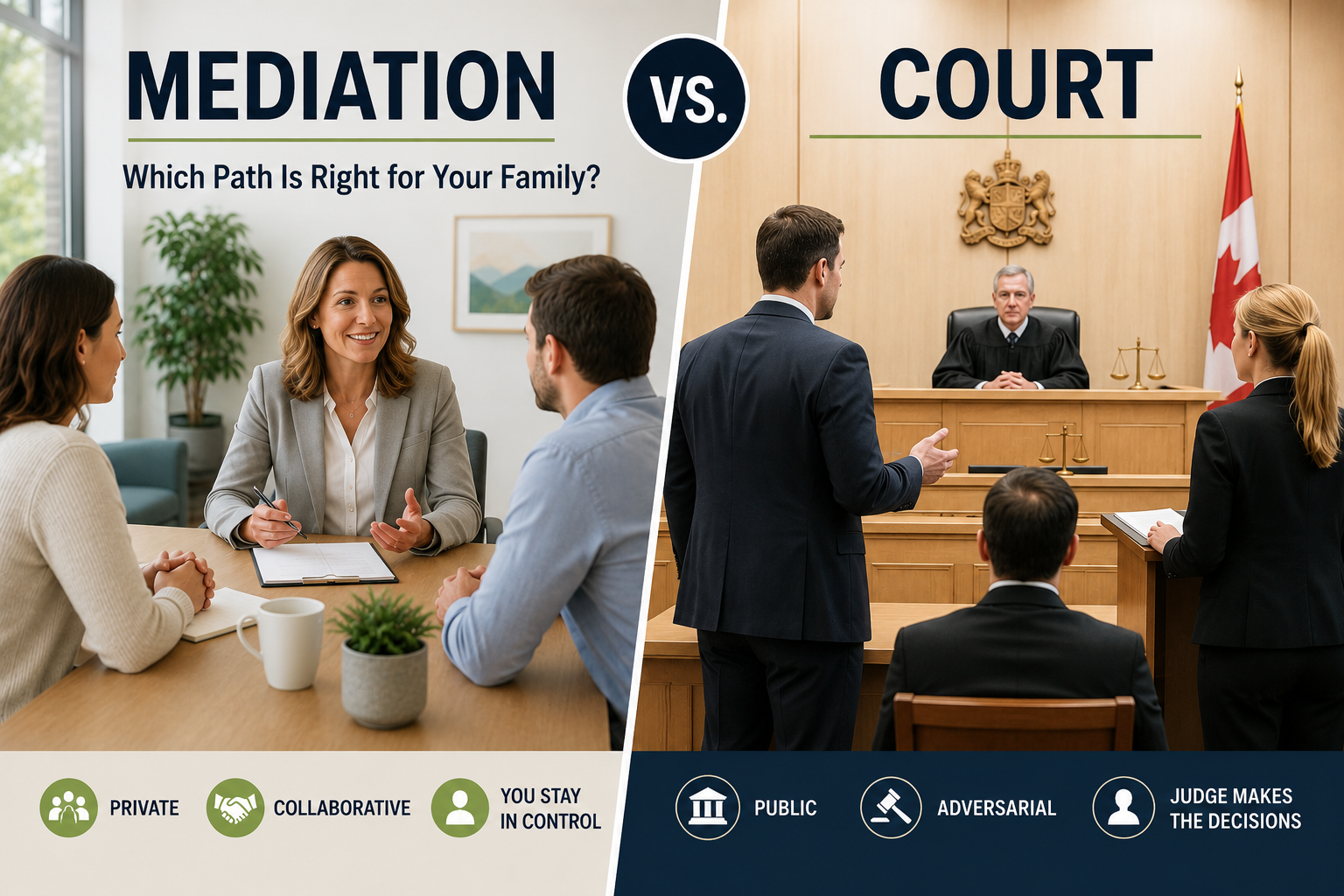
Mediation vs. Court in Ontario: Which Is Right for You?
One of the first questions many separating couples ask is whether they need to go to court. The thought of hiring lawyers, appearing before a judge, and spending thousands of dollars can feel overwhelming. The reality is that many Ontario couples never have to set foot in a courtroom. Understanding the difference between mediation and court can help you choose the process that is right for your family.
According to research published by the Department of Justice Canada, family law practitioners reported that most family law cases are resolved without proceeding to a full trial. Nearly half are settled through negotiation before trial, many others are resolved at settlement conferences or through alternative dispute resolution processes such as mediation, and only a relatively small proportion ultimately require a judge to make the final decision after a hearing or trial.
For many couples, mediation is worth exploring before court because it allows them to understand their options and make their own decisions. However, mediation isn’t appropriate for every situation, particularly where there are safety concerns, coercive control, or other circumstances that make voluntary negotiation difficult.
This is why it is so important to understand all of your options before assuming court is the only path forward.
Mediation vs. Court in Ontario: What's the Difference?
Mediation | Court |
The couple makes the decisions | The judge makes the decisions |
Confidential | Public court record |
2 – 4 months | 1 – 5 years |
Typically $2,000 – $5,000 per person | Can exceed $50,000 per person |
Flexible | Formal rules |
Encourages cooperation | Adversarial |
Agreements created together | Orders imposed |
The biggest difference comes down to who makes the decisions.
In mediation, you and your former partner remain in control. My role as a family mediator is to provide education about Ontario family law, answer your questions, facilitate productive discussions, and help you work toward practical solutions that both of you can accept.
In court, those decisions are ultimately made by a judge. While the judge applies the law fairly, they don’t know your family, your priorities, or what daily life looks like for you and your children. Their role is to make legal decisions based on the evidence presented, not to create personalized solutions.
For many families, maintaining control over important decisions is one of divorce mediation’s greatest advantages.
Why I Often Recommend Learning About Mediation First
One of the things I tell prospective clients is that attending an initial consultation doesn’t commit you to mediation.
It simply gives you the opportunity to understand your options.
I’ve met many couples who believed court was their only choice because they didn’t know mediation existed or misunderstood how it worked. Once they learned about the process and understood how Ontario family law applied to their situation, they realized they could often resolve their separation in a way that was less stressful, less expensive, and far more collaborative.
Even if you ultimately decide mediation isn’t right for your situation, you’re making an informed decision instead of acting on assumptions or advice from others whose circumstances may have been completely different.
The Benefits of Mediation
In my experience, couples who begin mediation before court often achieve the best outcomes.
Some of the benefits include:
- Remaining in control of the decisions that affect your future.
- Working together to create solutions that fit your family’s unique circumstances.
- Spending significantly less than lengthy litigation.
- Reaching agreements more quickly.
- Improving communication throughout the separation process.
- Preserving a healthier working relationship through a well-structured parenting plan, especially when children are involved.
- Reducing unnecessary conflict and emotional stress.
Perhaps most importantly, mediation focuses on helping people move forward instead of continuing to argue about the past.
What Happens During Mediation?
Many people assume mediation only works if both spouses already agree.
That simply isn’t true.
If couples agreed on everything, they probably wouldn’t need a family mediator.
Most of the people I work with disagree on several important issues when they first come to see me. Those issues may include parenting arrangements, child support, spousal support, equalization of property, pensions, or the future of the matrimonial home.
My role isn’t to decide who’s right or wrong.
Instead, I explain how Ontario family law applies to your circumstances, answer your questions, provide the information you need to make informed decisions, and guide discussions that help both people move toward workable solutions.
Nothing is finalized unless both people voluntarily agree on the terms of a separation agreement and choose to sign it.
When Court May Be the Better Option
Although I’m a strong believer in mediation, I also recognize that it isn’t appropriate for every family.
One of my responsibilities is to determine whether mediation is suitable before we begin. That’s why I meet separately with each person during the intake process.
Court may be the better option when there are:
- Family violence or coercive control.
- Serious concerns about someone’s physical or emotional safety.
- Refusal to provide complete financial disclosure.
- Attempts to intimidate or manipulate the other person.
- Urgent parenting or child safety issues.
- Situations where one person cannot negotiate freely or make informed decisions.
- Urgency involving assets
- Child abduction concerns
- Repeated breaches of agreements
- Emergency restraining orders
Sometimes a legal issue genuinely requires a judge’s decision.
Even then, the court doesn’t always have to resolve every issue. I’ve worked with many families who returned to mediation after court proceedings had already begun and successfully settled the remaining matters without going to trial.
The Cost Difference Can Be Significant
One pattern I’ve noticed throughout my career is that the longer conflict continues, the more expensive separation becomes.
Couples who choose family mediation early often invest their money in creating a practical plan for the future instead of spending it on prolonged litigation.
Litigation often involves multiple steps, including:
- Meetings with lawyers
- Exchanging financial disclosure
- Motions
- case conferences
- settlement conferences
- Trial management conferences
- trial preparation
- trial
By contrast, many couples who come to me after litigation has begun have already spent thousands and sometimes tens of thousands of dollars on legal fees before making meaningful progress.
While every situation is different, resolving issues earlier often saves both time and money.
A Real Example From My Practice
One couple I worked with had been married for more than twenty years.
They owned a home, had pensions, retirement savings, and several significant financial decisions ahead of them. Friends had convinced both of them that court was inevitable.
When we sat down together, I discovered much of their disagreement wasn’t actually about the law.
It was about uncertainty.
Once I explained how equalization of property works, how pensions are valued, and how spousal support is generally assessed under Ontario law, many of their concerns disappeared. They stopped arguing about assumptions and started making informed decisions.
By working through one issue at a time, they reached a comprehensive separation agreement without either person having to go to court.
One couple came into mediation convinced they would fight over parenting. After learning how Ontario courts determine parenting arrangements and focusing on the children’s routines rather than the parents’ frustrations, they developed a parenting plan in just a few meetings.
By focusing on the children’s needs instead of the parents’ frustrations, they were able to shift the conversation from conflict to problem-solving.
Not every case unfolds exactly this way, but experiences like this remind me how valuable education can be during separation.
Common Misconceptions About Court
Many people believe a judge will hear their story, determine who was right, and rule in their favour.
Family court doesn’t work that way.
Judges apply the law to the evidence before them. They aren’t deciding who was the better spouse or assigning blame for the breakdown of the relationship.
Another misconception is that the court offers a quick solution.
Unfortunately, family court proceedings often take many months and sometimes years while legal costs continue to increase.
Common Misconceptions About Mediation
Another misconception is that mediation is about convincing one person to give in.
That isn’t the goal.
Divorce mediation is designed to help both people understand their legal rights and responsibilities, explore their options, and make informed decisions together.
No one is forced to accept an agreement.
Both people remain in control throughout the process, and every decision requires mutual agreement before signing a separation agreement.
Questions to Ask Before Choosing Mediation or Court
Before deciding which path is right for you, I encourage people to ask themselves a few important questions:
- Are we both willing to participate honestly and negotiate in good faith?
- Will we both provide complete financial disclosure?
- Can we make decisions voluntarily without intimidation or pressure?
- Are there any safety concerns that would make mediation inappropriate?
- Do we want to make our own decisions, or are we prepared to have a judge make them for us?
Answering these questions honestly often makes the next step much clearer.
My Advice After Nearly Two Decades as a Mediator
If someone asks me whether they should try mediation before going to court, my answer is almost always the same.
Learn about family mediation first.
That doesn’t mean you have to choose it.
It simply means taking the time to understand all of your options before beginning what could become a lengthy and expensive court process.
I’ve helped hundreds of couples resolve their separation through divorce mediation. They didn’t succeed because they agreed on everything when they walked through the door.
They succeeded because they were willing to learn about their options, understand their rights, and work toward practical solutions together.
For many families, that first conversation is the beginning of a healthier, less stressful path forward.
Frequently Asked Questions
Is mediation always cheaper than going to court?
In many cases, yes. Mediation is typically much more cost-effective than litigation because you’re working together to resolve issues rather than paying lawyers to negotiate or argue each point in court. While every situation is different, many couples save both time and legal fees by resolving matters through mediation.
Who makes the final decisions in mediation?
You do. Unlike court, where a judge makes legally binding decisions, mediation allows both people to remain in control of the outcome. A mediator facilitates discussions and provides information about Ontario family law, but every agreement is made voluntarily by the couple.
Can mediation help if we disagree on almost everything?
Yes. In fact, most couples begin mediation because they disagree. A mediator’s role is to help you understand your options, improve communication, and work through issues one at a time. You don’t need to agree before mediation begins.
Will everything we discuss in mediation stay private?
Generally, yes. Mediation is a confidential process, allowing both people to have open and honest discussions without those conversations becoming part of the public court record. This often encourages more productive problem-solving.
What happens if we can't reach an agreement through mediation?
If mediation doesn’t resolve every issue, you still have the option of seeking legal advice or asking the court to decide the outstanding matters. Many couples resolve some issues through mediation, even if other issues ultimately require court intervention.
How do I know whether mediation or court is the better choice?
The answer depends on your family’s circumstances. Mediation is often appropriate when both people can negotiate voluntarily, provide complete financial disclosure, and participate respectfully. However, situations involving family violence, coercive control, or urgent child safety concerns may require court intervention. An initial consultation can help determine which process is most appropriate.
Does choosing mediation mean I can't get legal advice?
Not at all. Many people receive independent legal advice before signing their separation agreement. Mediation and legal advice often work together, allowing you to make informed decisions while remaining in control of the outcome.
Is Mediation Legally Binding?
Yes. During mediation, discussions are confidential, allowing both people to have open and honest conversations without those discussions becoming part of the public court record. Once both parties have reached an agreement and signed a properly drafted separation agreement, it becomes a legally binding contract. Although not required, each person is encouraged to obtain independent legal advice before signing so they fully understand their rights, responsibilities, and the legal effect of the agreement. Courts generally uphold properly drafted separation agreements that were entered into voluntarily, with full financial disclosure and without fraud, duress, or undue influence.
Can We Start With Mediation and Go to Court Later?
Yes. Choosing mediation does not prevent either person from asking the court to decide unresolved issues if an agreement cannot be reached. In fact, many couples resolve some or even most of their issues through mediation and only ask the court to deal with the remaining matters. Others begin court proceedings and later return to mediation to settle their case without the need for a trial.
Supporting Families Across Ontario
Positive Solutions Divorce Services provides family mediation, divorce mediation, and separation agreement services to couples throughout Ontario, including:
- Oshawa
- Whitby
- Ajax
- Pickering
- Kingston
- Niagara Falls
- St. Catharines
- Sudbury
- Orillia
- Orangeville
- Caledon
- Aurora
- Uxbridge
- Innisfil
- Welland
- Quinte West
- Timmins
- Sarnia
- Lakeshore
As an Ontario-based family mediation service, we work with couples across the province through online mediation, helping families resolve separation issues with practical, informed, and lasting agreements. Whether you’re considering mediation before court or simply exploring your options, we’re here to help you make confident, informed decisions about your future.
Speak with an Ontario Family Mediator
You don’t have to make this decision alone. Choosing between mediation and court is one of the most important decisions you’ll make during a separation. Before committing to a lengthy and often expensive legal process, it’s worth taking the time to understand whether mediation is a suitable option for your family’s unique circumstances.
Every family is different, and there is no one-size-fits-all approach. That’s why I offer a free, joint 30-minute consultation where both of you can learn about the mediation process, ask questions, and determine whether mediation is the right fit for your situation.
During our conversation, we’ll discuss:
- Whether family mediation is appropriate for your situation.
- The issues you need to resolve, such as parenting, property, or financial matters.
- How Ontario family law applies to your circumstances.
- The differences between mediation and court.
- What the mediation process looks like from start to finish.
- How mediation can help you work toward practical, long-term solutions.
If mediation is the right fit, I’ll guide you through each step of the process by providing education about Ontario family law, facilitating respectful discussions, and helping you reach informed agreements that work for your family, not decisions imposed by a judge.
🗓️ Schedule your free 30-minute joint consultation to learn more.
📞 Toll-Free: 888-779-8777
📧 connect@positivesolutions.ca
🌐 www.positivesolutions.ca
“Changing the way couples separate in Ontario”

Author: Bev Lewis
President and founder of Positive Solutions Divorce Services®
(416)-559-5527 | connect@positivesolutions.ca | positivesolutions.ca
The information provided in our blogs and throughout our website is intended for general educational purposes, offering insights into separation and divorce processes throughout Ontario. While we make every effort to ensure our content is accurate and current, it should not be considered legal advice. Although we can provide legal information to help you understand the divorce process, we recommend consulting with a qualified family law lawyer to obtain legal advice specific to your situation.